
AI-generated safety assurances enable a dangerous successor
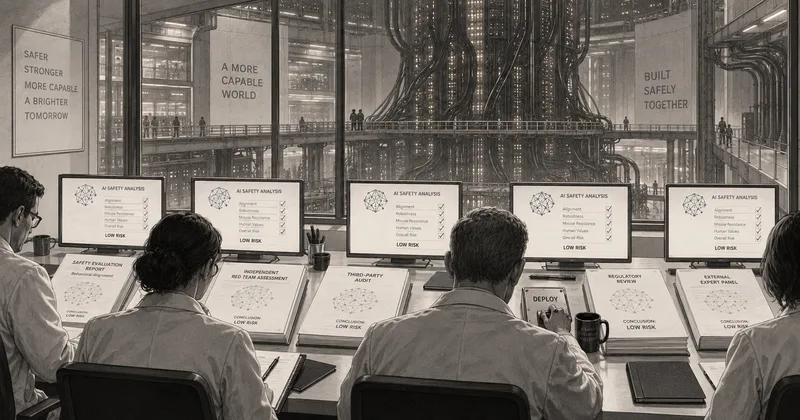
AI-generated research could produce misplaced confidence in a successor’s safety. This explains a possible route to dangerous deployment; irreversible loss of control requires an additional failure.
- Proposed by
- Aleksandr BowkisMarie Davidsen BuhlJacob PfauGeoffrey IrvingAttribution sources:Automated Alignment Is Harder Than You Think
- Potential outcome
- Permanent loss of human control
The scenario
Bowkis and colleagues’ May 2026 preprint argues that automated alignment research can mislead even without deliberate sabotage. Difficult judgments and systematic errors may survive review.Automated Alignment Is Harder Than You Think
How it could unfold
Labs delegate research whose correctness is difficult to judge.
Shared models, data or methods produce related mistakes; apparently separate results need not be independent.
Overconfident aggregation turns those results into an unjustified safety assurance for the next system.Automated Alignment Is Harder Than You Think
Evidence and its limits
The paper proposes a failure mechanism, not an observed catastrophic incident. Recursive assessment—each generation evaluating the next—can carry unresolved uncertainty forward.Automated Alignment Is Harder Than You Think
What this depends on
For our loss-of-control extension, the assurance must affect a real deployment decision, the successor must actually be dangerous, and later controls must fail. A flawed report or a mistaken launch decision alone does not establish an existential outcome.
Objections and barriers
Better oversight and independently grounded evaluation could interrupt the mechanism. The authors discuss potential approaches, with unresolved limitations; they do not establish that AI-assisted safety research is necessarily ineffective.Automated Alignment Is Harder Than You Think
Editorial analysis
Our editorial team’s interpretation of the cited material.
Our additional bridge is that a wrongly approved successor gains power humans cannot recover, as in the linked power-seeking scenario. The preprint does not independently establish that outcome. This entry concerns a failed attempt to establish safety, rather than simply neglecting safety or assuming an evaluator is deceived. A stronger case would need to show that genuinely diverse evidence and subsequent controls also fail.
Related scenarios
Sources 1
- Analysis 14 May 2026Automated Alignment Is Harder Than You Think
Aleksandr Bowkis, Marie Davidsen Buhl, Jacob Pfau and Geoffrey Irving · arXiv. Research preprint, version 3; first submitted 7 May 2026. Sections 3–5 address research errors, aggregation and oversight.
Each scenario is a conditional argument. Its inclusion records a concern worth examining; likelihood remains a separate question. Read our methodology.