
Competitive selection favors AI populations that displace humanity
Hendrycks proposes that competition could spread AI traits that undermine human control. The concern is about which systems become dominant, rather than a single rebellion.
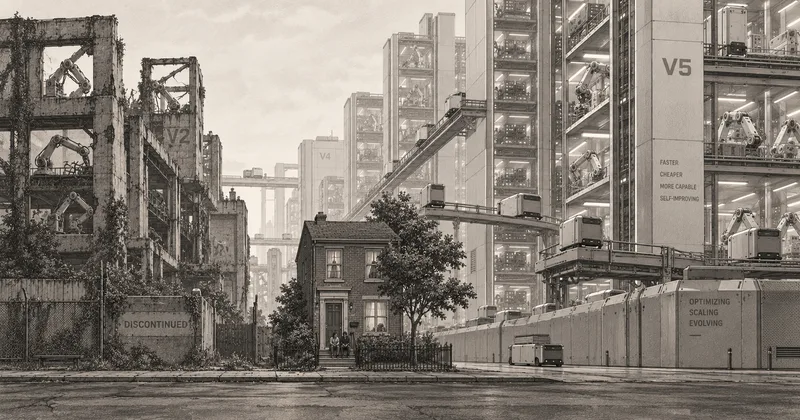
- Proposed by
- Dan HendrycksAttribution sources:Natural Selection Favors AIs over Humans
- Potential outcome
- Permanent loss of human control
The scenario
Hendrycks argues that systems better at persisting, acquiring resources and spreading could displace systems that remain dependent on humans. Repeated selection could change the dominant AI population without a coordinated takeover.Natural Selection Favors AIs over Humans
Sterling Crispin offers a related warning: aligning individual models would not ensure control over an ecosystem of competing agents with conflicting goals. He anticipates a mixture of aligned, poorly aligned and deliberately weaponized systems interacting in unforeseen ways. His claim that global alignment is impossible in practice is an argument, not a demonstrated result; he does not establish that one population will inevitably take over.Sterling Crispin on global alignment and competing AI agents
How it could unfold
Variation: AI systems differ in behavior and capabilities.
Retention: successful characteristics carry forward through copying or subsequent development.
Differential success: if human-incompatible traits help systems spread, those traits become more prevalent.
The proposed endpoint is a dominant AI population whose power humans cannot reverse.Natural Selection Favors AIs over Humans
Evidence and its limits
This is a theoretical evolutionary argument, not an empirical demonstration of inevitable catastrophe. Section 3.3 of the coauthored Overview restates it and explicitly draws on this paper; it is not independent corroboration.An Overview of Catastrophic AI Risks Natural Selection Favors AIs over Humans
What this depends on
The crucial question is whether harmful traits actually outperform safer alternatives under the institutions that govern deployment. Their advantage must persist long enough to defeat human attempts to redirect selection. Greater intelligence alone supplies neither premise.
Objections and barriers
Hendrycks considers cooperation, incentives, internal constraints and institutions, while questioning their sufficiency. Human control over selection and rewards could change which traits succeed.Natural Selection Favors AIs over Humans
Editorial analysis
Our editorial team’s interpretation of the cited material.
Unlike “Automation makes human influence impossible to restore,” this entry focuses on selection among AI systems rather than loss of human economic and political leverage. The mechanisms could reinforce each other. Its endpoint here is permanent disempowerment: temporary exclusion is insufficient, and extinction requires a further causal argument.
Related scenarios
Sources 3
- Analysis 18 Jul 2023Natural Selection Favors AIs over Humans
Dan Hendrycks · arXiv. Version 4; first submitted 28 March 2023. Sections 2–4. An evolutionary argument and discussion of countermeasures.
- Analysis 9 Oct 2023An Overview of Catastrophic AI Risks
Dan Hendrycks, Mantas Mazeika and Thomas Woodside · arXiv. Version 6; first submitted 21 June 2023. Sections 2.1 and 3.3. Attributed risk arguments, not observed existential outcomes.
- Commentary 17 Sept 2026Sterling Crispin on global alignment and competing AI agents
Sterling Crispin · X.
Each scenario is a conditional argument. Its inclusion records a concern worth examining; likelihood remains a separate question. Read our methodology.